

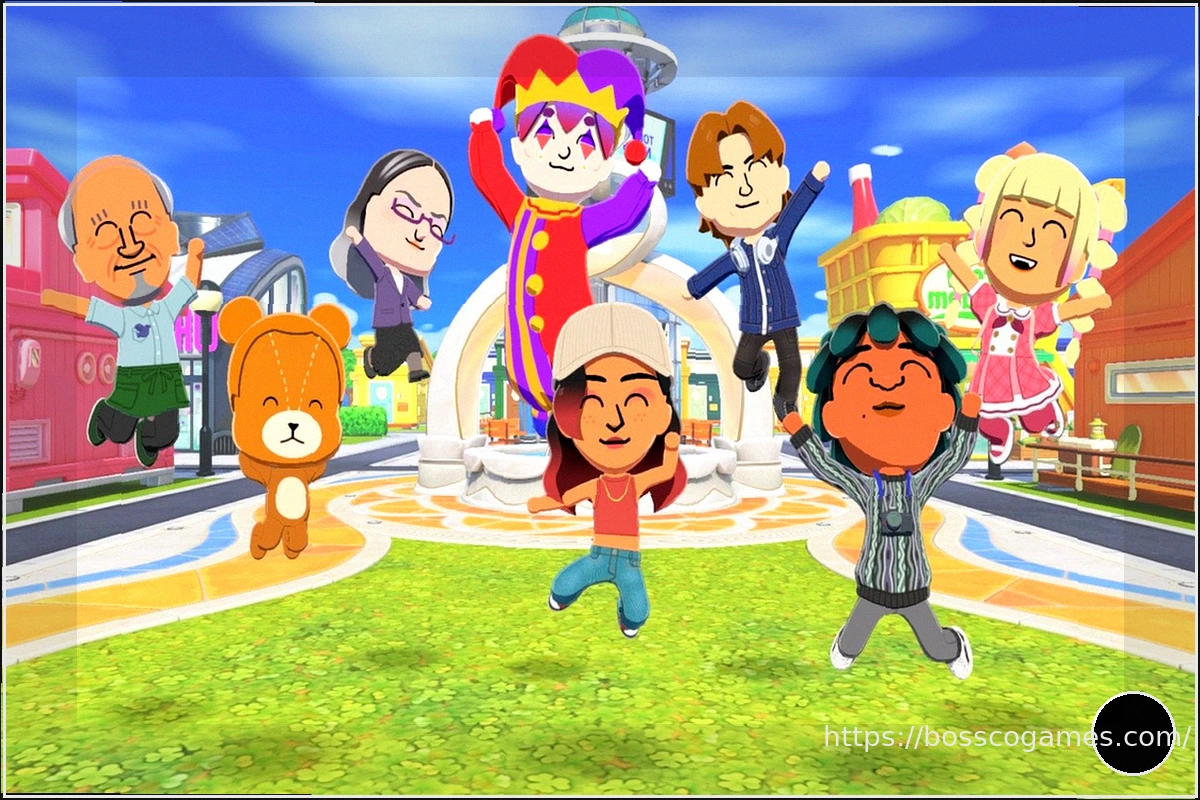
Be honest: how often do video games make you genuinely laugh out loud? Eliciting laughter is a complex and often thankless task, especially when avoiding vulgarity and aiming for surprise through sheer absurdity. While it’s rare for me, I distinctly remember bursting into boisterous laughter watching Bruno Barbieri, the newest resident on my Tomodachi Life: A Dream Life island, meticulously draw the enormous face of Antonino Cannavacciuolo in the sand, then proudly admire his masterpiece.
The judges of Masterchef – my TV guilty pleasure – are just a few of the characters I’ve created and invited to inhabit the island where I’ve become the ‘boss’ (a customizable title) in Tomodachi Life: A Dream Life, a follow-up to the 2013 Nintendo 3DS title. Describing Tomodachi Life is far from simple; even a broad definition like ‘life simulator’ doesn’t quite capture it. Rather than thinking of The Sims and its imitators, one should imagine an alternative dimension that shuns realism. Instead, it embraces the absurd and grotesque as its primary language, sometimes with an unsettling touch reminiscent of a dream world.
This new installment, set to arrive on Nintendo Switch on April 16th, introduces several enhancements over its predecessor. Notably, it offers more intricate character trait mapping for Miis and greater customization options for their island home. From its initial reveal, the player’s imagination has been central, as Tomodachi Life has always heavily relied on player creativity. As the opening anecdote suggests, players can create any historical figure, celebrity, family member, or friend, weaving hilarious relationships. With these premises, we delved into the game’s initial hours, and here are our impressions.
The First Citizen
Character creation naturally begins with the island’s first citizen. Players can create a Mii in two ways: a guided process or a free-form editor. The guided option generates an avatar based on responses to a series of questions that influence its appearance. The free-form editor is the classic Mii creator Nintendo fans are accustomed to. Compared to the prequel, character customization options have expanded significantly. By manipulating component sizes and fine facial details, players can craft characters that, while stylized, closely resemble their real-life counterparts. Nose, mouth, hair, and ears (a new addition) can be freely chosen, as can birthday, pronouns, sexual orientation, potential familial ties to existing islanders, and the game’s crowning jewel: the Mii’s voice.
All phrases spoken by characters are read by a voice synthesizer, which players can imbue with personality by adjusting tone, pitch, intensity, speed, and inflection. Much of the characters’ comedic effect stems from their hilariously precise and often bizarre speech, with the ability to fine-tune word pronunciation via a secondary menu for adding accents. The results are side-splittingly funny. I spent minutes trying to perfectly replicate Cannavacciuolo’s voice, fully embracing the inherent “trash” humor of the game.
Finally, players complete a profile that defines the Mii’s personality: how formal or relaxed they are with others; whether they are original or serious; energetic or phlegmatic, introverted or extroverted. Tomodachi Life processes all this information to generate a character profile and assign an archetype: the dreamer, the creative, the reserved, and many others. Each archetype comes with its own preferences, from favorite foods to clothing styles and compatible personality types. In essence, every Mii is a unique blend of player-defined parameters and game-derived inferences.
But the depth doesn’t end there. One of Tomodachi Life: A Dream Life’s stated goals is to pursue an increasingly detailed character model. Each Mii has a happiness level that can be increased through gifts, food, and relationships. As Miis level up, players can further personalize their character and behavior. For example, gifting an item like a musical instrument allows them to interact with others. Players can also unlock unique walking styles, standing poses, or even a signature gesture exclusive to that Mii on the island. Even a catchphrase can be added to their vocabulary, which then spreads among the inhabitants, circulating throughout the town.
A Dream Island
If Miis represent half the soul of Tomodachi Life: A Dream Life, the other half – and perhaps the most intriguing new feature – is undoubtedly the island itself. The island is a constantly evolving place, which, much like the Miis, develops a distinct personality as its inhabitants grow in number and quality of life. The game’s tutorial gradually introduces us to the possibilities offered by various buildings that will open up in the Miis’ living space, creating a network of systems that interact with their desires and needs. A pivotal point is the Fountain of Happiness, where accumulated happiness points (poetically called “batuffoletti” or “fluffballs”) can be exchanged for rewards that expand character customization options. These include new ways of walking, eating, or greeting, as well as items like guitars, aerobic DVDs, soccer balls, and many other bonuses we won’t spoil for you. Consulting the fountain is crucial, as it governs the game’s progression, allowing players to build an increasingly detailed island and cast of characters.
The island quickly fills with buildings that cater to Mii needs: a supermarket, for instance, where daily food purchases feed characters and track their culinary preferences; a clothing store to personalize outfits and ensure comfort; a renovation center for uniquely furnishing home interiors; a design studio to create objects, clothes, and general patterns for various contexts; and finally, an urban planning center, allowing city restructuring by adding benches, vending machines, fountains, streetlights, and more. Each object promises unique interactions with characters, offering glimpses into more entertaining Mii-involved scenes.
Indeed, hopping from character to character, fostering friendships or romances, and eavesdropping on fragments of Mii conversations is the very essence of Tomodachi Life: A Dream Life. Its emergent narrative, composed of small life fragments—sometimes remarkably believable, sometimes hilariously absurd—functions magnificently. Miis crave social interaction; they often consult you for advice on relationships, whether to pursue a crush, or to suggest a common topic to chat about with a Mii they like. Here too, you can intervene by suggesting activities, objects, or people to discuss. For example, I suggested Barbieri talk to my Mii about Stephen King, my favorite author. The two began discussing it, the word spread, and now everyone on my island talks about the Maine writer.
Clearly, Tomodachi Life: A Dream Life follows a very simple rule: it functions based on the player’s investment of imagination. The more one can dance on the thin line between nonsense and plausibility, the more the game will deliver paradoxical situations and potential meme material. The initial hours are hilarious, also because it’s fun to see all the ways – sometimes unexpected – Miis confront daily life: their conversations, the sometimes unsettling dreams they have at night, the countless roles they play in the daily narrative. To truly understand how long this suspended sense of hilarity can last, however, more hours of gameplay are needed.
Verdict
It’s challenging to confine Tomodachi Life: A Dream Life within a single definition. This game constantly strives to defy player expectations, taking the imaginative input – from invented Miis and discussion topics to designs and catchphrases – and reshuffling it to create situations that border on the absurd and grotesque. It’s a life simulator, yes, but one with its own unique rules and a consistent goal: to surprise the player. So far, we’ve experienced the new island customization features and the depth of the system that allows for assigning increasingly unique characteristics to characters, thoroughly enjoying watching them form surprising relationships. There’s still much to discover about how the lives of these quirky avatars will unfold on an island that, every day, offers new stimuli to both them and the player.
Pros
- A game that champions good humor.
- Consistently manages to make the player laugh.
- Robust Mii and island customization system.
Cons
- Relies heavily on player imagination.
- Questionable long-term freshness.
- Some players might feel a lack of overarching objectives.