

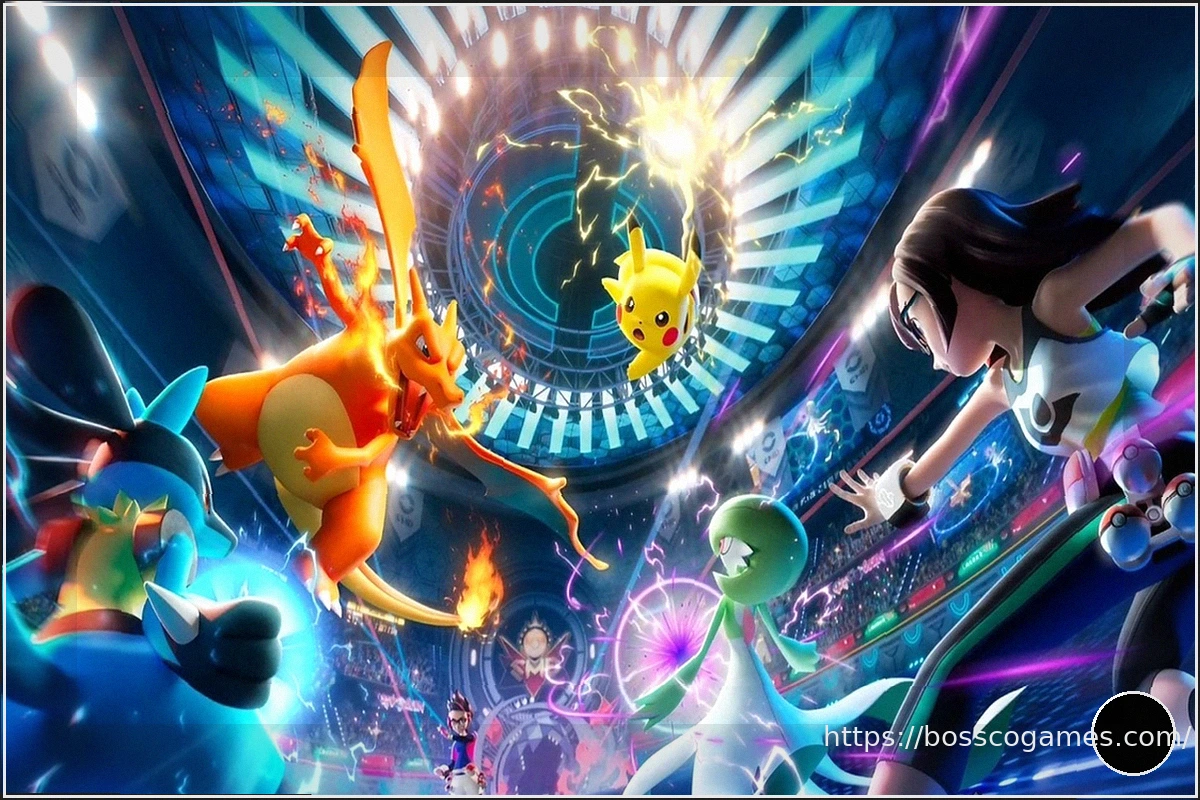
Since The Pokémon Company unveiled Pokémon Champions during the Pokémon Presents on February 27, 2025, the competitive community has been buzzing. This isn’t a traditional main series title: there are no badges, no Gym Leaders, and no grand adventure to complete. Champions is a game designed entirely around battle, structured as a live service intended to last “forever”—or at least, as long as Pokémon itself, as project lead Masaaki Hoshino emphasized.
Available on Nintendo Switch (and Switch 2 via backward compatibility) starting April 8, 2026, and subsequently on iOS and Android later that summer, the game is poised to become the official platform for VGC tournaments. It’s already confirmed to host the 2026 World Championships in San Francisco.
During the European Championships in London, we not only witnessed one of the season’s most important esports events but also had the chance to play, for the first time, what is arguably The Pokémon Company’s most ambitious move in 30 years. The Japanese company, often accused of being resistant to change, has decided to break the long-standing dichotomy that has defined the series: the inseparable link between a main series chapter and competitive gameplay.
Breaking Down Barriers
One of the secrets behind the Pokémon series’ global success is that, behind the colorful and innocent facade of its pocket monsters, lies a complex video game with ruthless mathematics. Historically, Pokémon Champions in the main series games reach the top after months of intense training. This involves understanding their team’s effectiveness, the synergy between moves and types, and painstakingly searching for the perfect Pokémon through breeding and exhaustive training. This mix of talent and dedication inevitably created a high barrier for newcomers: it wasn’t enough to simply catch or evolve a Rillaboom to have a champion; it had to be meticulously trained to possess the exact stats and abilities required to face other teams.
Masaaki Hoshino has approached Champions similarly to Pokkén Tournament: his objective is to make an extremely competitive and niche genre accessible to everyone. He aims to break down entry barriers to allow players to focus directly on pure gameplay and competitive matches. Additionally, he seeks to create a unique platform for competitions that can evolve dynamically over time. In essence, it’s a game as a service, with its own set of rules, limitations, but also undeniable potential.
Platforms and Backward Compatibility
As noted, the game will launch on Nintendo Switch on April 8, 2026. Simultaneously, Nintendo Switch 2 owners will receive a free update to enhance the graphical quality on the new console, without altering the game’s content. The mobile version for iOS and Android is expected in summer 2026, though a precise date has not yet been announced.
Naturally, the game will be free-to-play, cross-progression, and cross-platform. In simpler terms, this means players can compete with anyone regardless of their platform, and their game progress will be accessible across all devices, much like in Pokémon Unite.
Champions was developed by The Pokémon Works—a joint venture formed in 2024 between The Pokémon Company and ILCA, the studio known for supporting Pokémon HOME—under the strategic direction of Masaaki Hoshino, a veteran who previously produced Pokkén Tournament and Pokémon Unite.
The Economic Model: Free, but with a Catch
While the game will be free to download on all platforms, it will, by necessity, include mechanisms that encourage microtransactions. For instance, a paid Starter Pack will be available from launch, offering additional Pokémon storage space, battle music from Pokémon: Let’s Go Pikachu! and Let’s Go Eevee!, 30 Companion Tickets, and 50 Training Tickets. The Pokémon Company is expected to offer cosmetic items such as new music, inventory slots, and outfits for real money, rather than elements that would impact gameplay balance.
There will be both a free Battle Pass and a Premium one, which includes a greater number of items, Mega Stones, outfits, icons, and more. A subscription, meanwhile, will increase storage space, expand the number of available teams, grant access to special missions, and unlock additional battle music. European prices have not yet been officially announced, but the Battle Pass is expected to cost approximately 9 euros per season, the Starter Pack 5 euros, and the subscription 4 euros per month.
Similar to Pokémon GO and Unite, the primary driver for purchases will likely be the customization of avatars and Pokémon. Hopefully, this won’t lead to the confusing currency systems seen in some MOBAs, which could deter many players. What is certain is that Victory Points cannot be purchased and must be earned through gameplay.
How Are Pokémon Recruited?
The recruitment system operates in two distinct ways. The first method involves transferring Pokémon from Pokémon HOME, the central application for all Pokémon experiences. Players can bring creatures obtained in main series games and Pokémon GO into Champions, provided their species are included in the game’s Pokédex. Pokémon transferred from HOME are considered “guests” and can be returned; if trained in Champions, they will retain their training results upon returning to HOME, unless they change form. If they acquire Champions-specific moves, these will be lost when they go back.
The transfer from HOME to Champions remains a one-way street for Pokémon originated directly within the game: pocket monsters obtained in Champions cannot be deposited into HOME or transferred to other titles in the series. This choice clearly addresses the need for competitive balance.
The second method is in-game. Once a day, players can choose a Pokémon from a random selection of 10 to add to their group. These Pokémon are temporary and usable for only one week unless Victory Points are spent to keep them permanently. Naturally, there will be ways to perform more than one daily draw using various in-game currencies. Once a player has at least 6 Pokémon, they can assemble a team and enter online battles.
How to Play
Once on the battlefield, the differences between Pokémon Champions and the main series titles are minimal. After all, the core gameplay is still built upon the rules established by Shigeki Morimoto 30 years ago in Red and Green, rules that the brilliant Game Freak programmer continues to expand and manage for the company.
To simplify, it’s as if The Pokémon Company took the entire online battle structure of Scarlet and Violet and transformed it into a standalone experience, without significant variations. Therefore, anyone familiar with the series will find it very easy to navigate the game menus, as everything is where expected and functions as intended, with no major changes.
Thus, we are presented with a classic turn-based combat system where two teams of 6 Pokémon face off in single or double battles. The battle progression is also traditional, with trainers deciding their move or item to use before each turn, then observing the outcome of their strategy on the field. The entire system of strengths and weaknesses is carried over unchanged into Champions from Scarlet and Violet, with only the addition of some specific moves for certain Pokémon (like those seen in Z-A) and the possibility, depending on season rules, to mix, for example, Z-Moves with Mega Evolutions.
The winner, of course, will be the one who defeats all opposing Pokémon.
The Victory Point System
One of the major innovations in Champions, and the reason we assert that entry barriers have been significantly lowered, is the abandonment of the traditional IV and EV system. Champions replaces years of breeding and farming with a more direct system where Victory Points can be freely spent to change Pokémon moves, modify their nature, alter abilities, and completely adjust stats. Each Pokémon, in fact, has 66 points that can be distributed according to the trainer’s specific needs. In other words, two Dragonite won’t necessarily be identical; they can have different setups depending on whether you want to specialize them in attack or defense. All of this will simply depend on the trainers’ strategic choices, rather than chance or complex breeding formulas.
Victory Points can also be used to purchase items to bring into battle, such as Mega Stones, various helmets or potions, as well as outfits, music, and victory poses to display at the end of a match.
When the game releases, it will be interesting to see how veterans react to these changes: on paper, ‘only’ the extensive labor required to obtain perfect Pokémon has been eliminated, leaving the core gameplay intact. Will this be enough to maintain strategic depth?
The Three Game Modes
Battles are available in three formats: Ranked Battles, where players compete against opponents of similar skill to climb the global leaderboard; Casual Battles, which do not record wins or losses, allowing for free experimentation; and Private Battles, with dedicated rooms for challenging acquaintances. All three formats support both Single and Double Battles, with the latter utilizing the classic six-Pokémon team format from which four are selected for each encounter.
Online Competitions are also planned, featuring established regulations that change after each season. Masaaki Hoshino’s goal is to keep the game fresh by rotating rules, pocket monsters, and other elements, thereby shaking up the meta every few months through the introduction of new rules, balance adjustments, and especially unique gimmicks.
Mega Evolutions and New Abilities
One of the project’s most delicate aspects is how Champions will successfully integrate all the various moves and abilities seen throughout the years. In the game, each trainer will possess a device called the Omnicerchio, potentially capable of activating every type of power, from Terastallization to Z-Moves. But how will these interact with each other? According to Hoshino himself, balancing these ‘super moves’ will be the development team’s most complex task. While we’ve seen how these abilities interact in the latest season of the anime with Ash, creating a balanced competitive game around all of them is considerably more intricate.
For now, only past abilities are present, but soon, those characterizing upcoming titles will be introduced, starting with Pokémon Legends: Z-A, and extending to Pokémon Wind and Pokémon Wave. For example, the first additions to the current meta will include creatures from Z-A like Mega Meganium, Mega Emboar, and Mega Feraligatr, all three featuring special moves not previously available in the competitive scene.
Launch Bonuses and Connection to Legends: Z-A
Players who download the game by a specified date will receive a Dragonite directly in their in-game mailbox. By transferring Chesnaught, Delphox, Greninja, and Eternal Flower Floette from Pokémon Legends: Z-A to Champions via HOME, players will be able to obtain their respective Mega Stones. This link between the two titles is not accidental: Mega Dragonite is one of the Mega Evolutions also announced in Legends Z-A and will be available from the launch of Champions.
Official Competitive Calendar
The Pokémon Video Game Championship (VGC) will transition to Pokémon Champions as the standard platform for all competitive matches, beginning with its launch on Nintendo Switch on April 8, 2026. The Indianapolis Regional Championship will be the first official Pokémon Championship Series event to exclusively use Champions as its platform, taking place from May 29-31. Champions will then host all subsequent Premier events, including the North American International Championships from June 12-14 and the World Championships from August 28-30. Players eager to compete before Indianapolis can do so in an official context even earlier: Global Challenge I will be held from May 1-4, utilizing Champions with Regulation M-A, though it will not award Championship Points in TPCi-managed regions.
The transition will occur gradually: for regional tournaments in April and May, Champions will be used in secondary events, while for the 2027 season, Champions will become the mandatory platform for all events awarding Championship Points.
Verdict: Certainties & Doubts
With Pokémon Champions, The Pokémon Company International (TPCi) attempts its most ambitious move in 30 years: separating the competitive aspect from the main series titles. In doing so, it aims to open its esports ecosystem further to the general public, reaching them on iOS and Android and eliminating the huge barrier to entry that was capturing and meticulously training the perfect monster, to focus purely on gameplay. Microtransactions and gameplay simplification are the major unknowns of the project. Fortunately, starting April 8, all these doubts can be dispelled, as Champions aims to become the definitive platform for competitive Pokémon.
CERTAINTIES
- The core gameplay formula remains unchanged.
- Free-to-play and cross-platform.
- The seasonal format could invigorate the meta.
DOUBTS
- Will the simplifications appeal to everyone?
- Will microtransactions be omnipresent?